Why speaking with a teenage native speaker every day changes everything
Language learning research consistently shows the same thing: the most powerful driver of spoken fluency is not grammar instruction, vocabulary drills or even hours in class. It is sustained, meaningful interaction with a native speaker — especially one who is the same age.
This guide explains the science behind the 1:1 method, why peers outperform adults as language partners for teenagers, and what a week at Speak Teens actually looks like in practice.
What research says about language acquisition
Stephen Krashen's Input Hypothesis established that language is acquired, not learned: fluency comes from comprehensible input in a low-anxiety environment, not from memorising rules. When a student is relaxed, engaged and motivated, acquisition happens naturally — almost without effort.
Vygotsky's Zone of Proximal Development adds another layer: learners advance fastest when they interact with someone slightly ahead of them. A teenage native speaker sits in exactly that zone — linguistically ahead of an Italian student, but culturally and emotionally on the same level.
Why peers outperform adult teachers as conversation partners
Adult teachers are essential for structured lessons. But when it comes to generating the kind of natural, sustained conversation that builds real fluency, a teenage native speaker has advantages no adult can replicate:
- Shared topics. Music, sport, social media, films, games — teenagers talk about the same things. The conversation is genuine, not performed.
- No power dynamic. Talking to a teacher involves an implicit assessment relationship. Talking to a peer does not. Students speak more freely, make more mistakes, and recover faster.
- Authentic register. Native-speaking teenagers use the same slang, contractions and rhythm that Italian students will encounter in real life — not textbook English.
- Accents and variety. Exposure to multiple accents — British, Irish, American, Australian — builds the listening flexibility that matters most for real-world communication.
What 1:1 means in practice at Speak Teens
At Speak Teens, every Italian student is paired with a Teen Anglo — a native-speaking peer aged 13–17 from the UK, Ireland, USA, Canada or Australia — for dedicated one-to-one sessions each day. The Anglo rotates daily, so over the course of the week each student interacts with multiple native speakers from different countries.
These sessions are structured but informal: the TEFL teacher prepares a prompt or scenario in the morning lesson, and the one-to-one session gives the student space to use the language in a real conversation with no audience and no pressure.

Beyond the one-to-one sessions
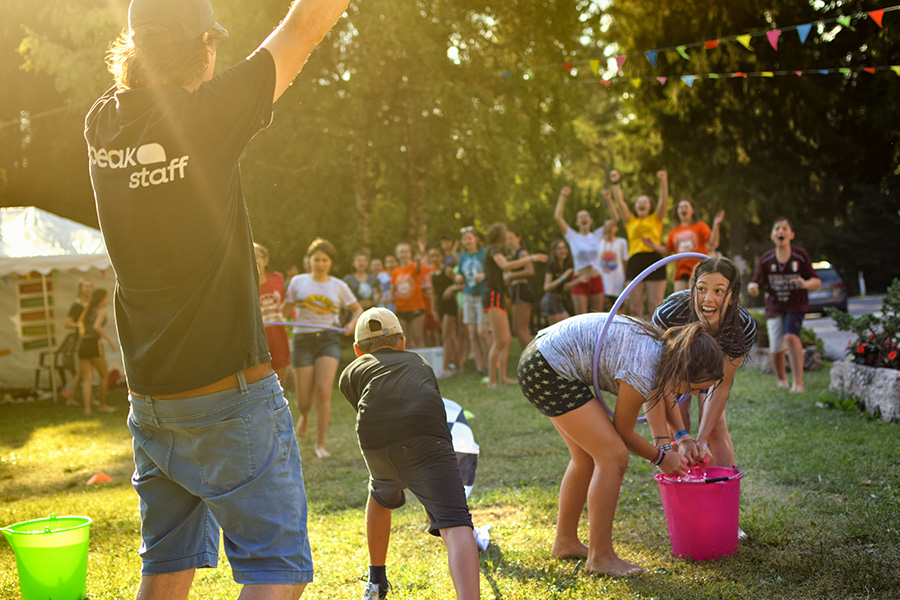
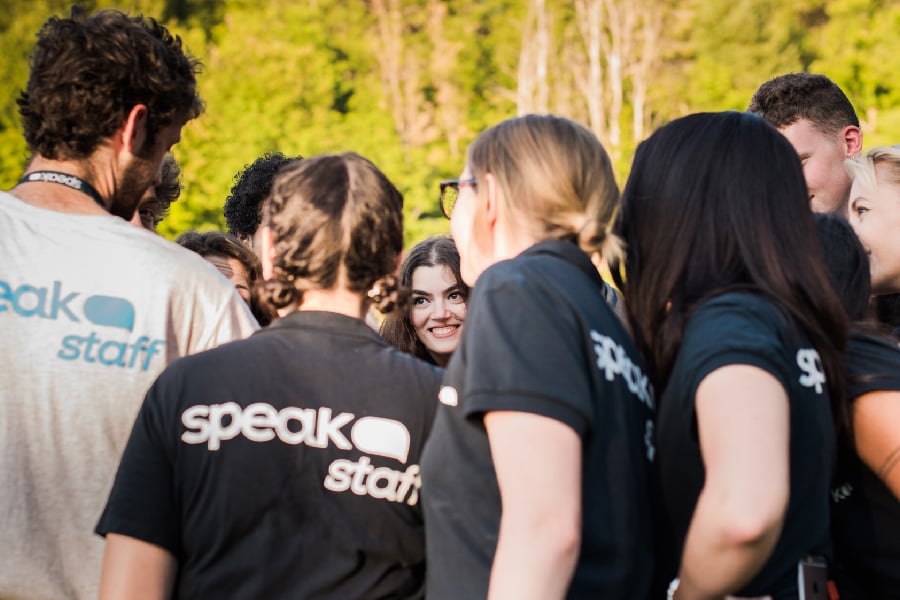
The 1:1 method is not confined to a scheduled session. At Speak Teens, the student-to-Teen-Anglo ratio is 1:1 across the entire camp — which means every meal, every activity, every evening event and every excursion happens alongside a native speaker.
This matters because acquisition requires volume. A one-hour conversation class three times a week is not enough to build fluency. Eight days in which every waking hour involves English — at breakfast, on the football pitch, during the full-day forest adventure park excursion, at the evening quiz — is a fundamentally different experience.
The Language Assessment completed online before arrival ensures that each student is grouped with peers and Anglos at an appropriate level for structured lessons. The free-flowing conversation that happens the rest of the day is naturally scaffolded by context, not by curriculum.
What students and families notice
The change parents observe most often is not in vocabulary or grammar — it is in confidence. Students who arrived reluctant to speak a word of English return home willing to try, faster to respond and less afraid of making mistakes.
That shift happens because the camp's environment removes the two biggest barriers to spoken fluency: fear of judgment (there is no audience) and lack of opportunity (English is simply the medium of daily life for the whole week).
One session. One student. One Anglo. No audience.
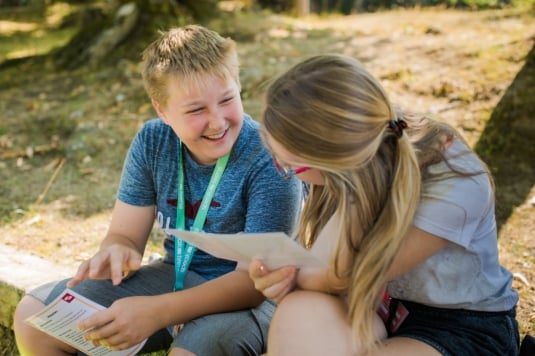
Every day at Speak Teens, every student has a dedicated one-to-one session with a Teen Anglo — just the two of them. No classmates listening. No teacher watching. No pressure to be right.
That environment is where the real language learning happens: when a student risks a sentence they have never said before, gets a natural response, and discovers they were understood.

The Cambridge English Skills Test
For students who want a certified result at the end of camp, Speak Teens offers the Cambridge English Skills Test — one of the first centres in Italy to do so. The test is optional and taken on the last day of camp. It assesses the listening, speaking, reading and writing skills developed during the week.
Two camps run in summer 2027: Camp 1 (3–10 July) and Camp 2 (10–17 July), both at Valbonella, Bagno di Romagna, in the Emilia-Romagna Apennines. Ages 10–17.