Why Italian teenagers struggle with English — and what actually works
Italy consistently ranks among the lower-performing European countries in English proficiency, despite years of compulsory English in schools. Italian teenagers study English from primary school onwards, yet many arrive at university unable to hold a basic conversation.
This guide looks at why the standard approach produces weak results, what the research says about effective language learning for adolescents, and what a week at Speak Teens does differently.
Why school English does not produce fluency
The problem is structural. Italian school English is built around written grammar, translation exercises and reading comprehension — skills that are assessable in a classroom context but that bear almost no relationship to spoken fluency.
Studies of classroom language learning consistently show that the amount of authentic spoken interaction a student gets in a typical lesson is minimal: a few seconds per student per hour, mediated through the teacher, with no real communicative pressure. That is not enough to build the neural pathways that support spontaneous speech.
Three specific factors compound the problem for Italian teenagers in particular:
- Fear of error. Italian classroom culture places high value on correctness. Students who are afraid of making mistakes in front of peers speak less, and therefore improve less.
- Lack of real input. Most English encountered in Italian schools is simplified, scripted or translated. Students rarely hear native speakers at natural speed, using natural vocabulary.
- No communicative necessity. Italian students can get through a school day — and most of their social life — entirely in Italian. There is no pressure to use English for anything that actually matters.
What the research says about adolescent language learning
The research on second language acquisition points consistently in the same direction: fluency comes from meaningful, sustained interaction with native speakers in a low-anxiety environment — not from grammar instruction.
Adolescents have a particular advantage over adults in this regard: they are more socially motivated than younger children, more capable of abstract reasoning, and highly sensitive to peer approval. When their peers are native speakers of English, the social motivation to communicate in English becomes very strong.

What changes at a full-immersion camp
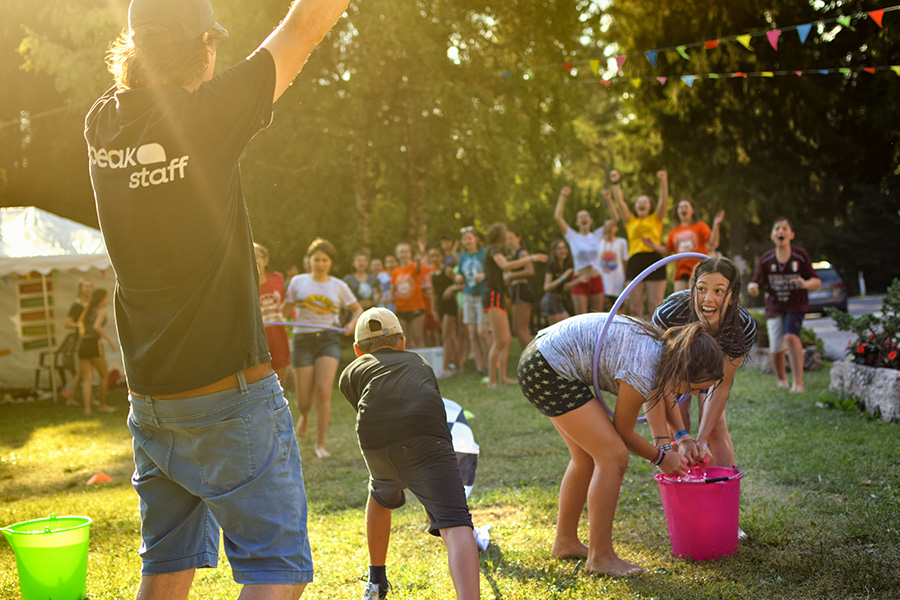
An immersion camp removes the three structural problems of school English simultaneously:
- Fear of error disappears when the conversation partner is a peer, not a teacher, and there is no audience and no grade.
- Real input becomes constant when every native speaker around you is speaking naturally, at natural speed, using natural vocabulary.
- Communicative necessity is total when you need English to get through every meal, every activity and every conversation of the day.
The result is that acquisition — the unconscious process by which language becomes automatic — happens at a rate that is simply not possible in a classroom setting.
The role of the peer relationship
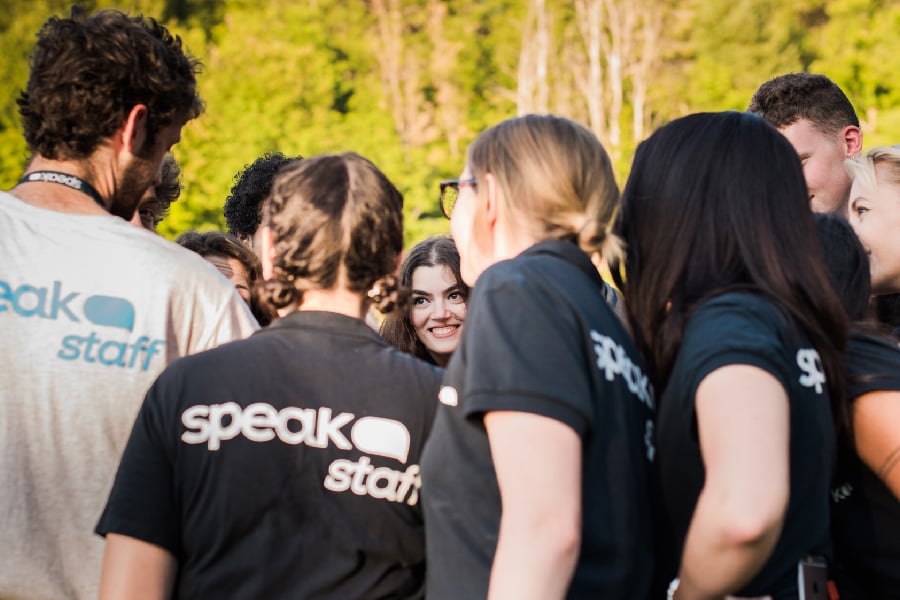
What makes the Speak Teens model particularly effective for Italian teenagers is the age of the native speakers. Teen Anglos are peers — 13 to 17 years old, talking about the same things Italian teenagers talk about, with no power differential.
When a 16-year-old from Manchester talks to an Italian student about football, music or social media, the Italian student is not performing English. They are having a conversation. The acquisition happens as a by-product of communication, not as its goal.
Eight days. A structural change.
One week of immersion does not make a student fluent. But it does something that years of classroom English cannot: it shows them what it feels like to communicate in English without fear, and it builds the confidence to keep going.
The students who make the most progress at Speak Teens are not the ones who arrive with the best grammar. They are the ones who arrive willing to try.
After camp: maintaining the gains
The confidence shift that happens during camp is real, but it needs reinforcement. Students who continue to use English actively after camp — through films, music, social media, online friendships with their Teen Anglos — build on the foundation the week creates. Those who return to passive school English alone will find the gains fade faster.
Speak Teens provides families with guidance on how to support continued English use after camp. The friendships students form with Teen Anglos are themselves one of the most effective maintenance tools: a reason to keep communicating in English that is genuinely motivating.
Camps run 3–10 July (Camp 1) and 10–17 July (Camp 2) 2027, at Valbonella, Bagno di Romagna. Ages 10–17.