Can an app teach your child English? And if not, what can?
Language-learning apps have become remarkably capable. AI tutors can hold conversations, correct grammar in real time and adapt to a learner’s level with impressive precision. So the question parents are increasingly asking is a reasonable one: do I need to send my child to a summer camp, or can they get the same result from an app?
This guide looks honestly at what apps do well, where they fall short for teenage learners, and what a week of human immersion does that no algorithm can replicate.

What apps do well
The best language-learning apps are genuinely impressive tools. They are good at:
- Vocabulary building. Spaced repetition systems are more effective than traditional flashcards and significantly better than classroom vocabulary lists.
- Grammar pattern recognition. Apps can expose learners to thousands of grammatical patterns in context, with immediate feedback.
- Pronunciation feedback. AI speech recognition has improved to the point where apps can give useful, real-time feedback on individual sounds.
- Consistency. An app is always available. It never has a bad day, never gets impatient and never makes a learner feel embarrassed.
These are real advantages. For a motivated adult learner with a specific goal — preparing for a certification exam, building vocabulary in a new professional field — an app can be a highly effective tool.
Where apps fall short for teenagers
The limitations of apps as a primary learning tool for teenagers are structural, not technical:
- Motivation. Teenagers are social learners. They are motivated by real relationships, real stakes and real consequences. An app conversation has none of these. The dropout rate for teenage app learners is very high.
- Spontaneity. Apps can simulate conversation, but they cannot replicate the unpredictability of real dialogue: the interruptions, the topic changes, the moments where you have to find a word you do not know in real time.
- Social and cultural context. Language is not just vocabulary and grammar. It is tone, register, humour, timing. These things are learned by watching and participating in real human interaction — not by talking to a chatbot.
- The confidence problem. An app cannot embarrass a learner, but it cannot help them overcome the fear of real human interaction either. A teenager who is fluent at talking to an AI but terrified of speaking to a native speaker has not solved the problem that matters.


What human immersion does that apps cannot
The core difference between app-based learning and human immersion is not about content — it is about stakes and relationships.
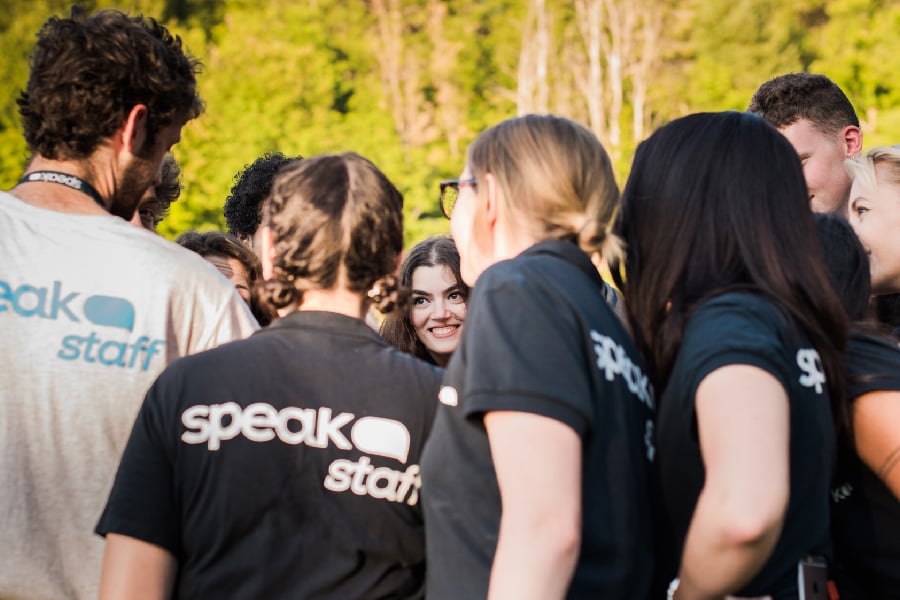
When a teenager speaks English to a Teen Anglo at Speak Teens, something real is at stake: being understood, connecting with someone, getting to the next activity. That stakes-based pressure is what drives acquisition. Apps have no stakes. The learner can close the app at any point, and nothing actually happens.
The relationship is equally important. A teenager who has spent a week with a native-speaking peer from Ireland has a reason to keep using English after camp ends: to maintain that friendship. That ongoing social motivation is the most powerful driver of continued language development — and it cannot be engineered by an algorithm.
The honest answer: apps and camps serve different purposes
Apps are good preparation tools and good maintenance tools. Using an app in the weeks before camp to build vocabulary and refresh grammar is sensible. Using one after camp to maintain gains is sensible.
But an app cannot substitute for the experience of living in English for eight days alongside native-speaking peers. The two things are not in competition — they address different parts of the learning challenge.
The one thing AI cannot do
No AI can make a teenager care about communicating in English. That requires a person on the other side of the conversation — someone whose response is real, whose reactions matter, and who exists beyond the conversation itself.
That is what a Teen Anglo is. And it is why the 1:1 ratio at Speak Teens produces results that no app, however sophisticated, has yet come close to matching.

Using technology to support the camp experience
At Speak Teens, we encourage families to use apps in the weeks before camp — especially for vocabulary building and listening practice. The Language Assessment completed online before arrival helps group students at the right level for structured lessons.
After camp, the friendships students form with Teen Anglos are the most effective maintenance tool available: a real reason to keep using English, with a real person who is waiting for a message.
Camp 1 runs 3–10 July 2027. Camp 2 runs 10–17 July 2027. At Valbonella, Bagno di Romagna. Ages 10–17.