English summer camp in Italy or abroad: what actually works?
The question Italian families ask every summer has a more nuanced answer than it seems. The geographical destination matters less than the quality of immersion. What makes the difference is how many hours a day your child actually speaks English with native speakers — not whether they are in London or in the Apennines.

The problem with study abroad: what research shows
Language schools abroad have been the reference model for decades. The idea is sound: surround your child with English for 2–3 weeks. In theory. In practice, three structural problems emerge: (1) Italian students tend to group together outside lesson time and return to speaking Italian; (2) classes are mixed by level, not age — a 15-year-old may be in class with adults; (3) actual speaking time rarely exceeds 20–30 minutes a day.
The result is that the real exposure to English is much closer to 3–4 hours a day than to full immersion.

Real English hours per day
Study abroad: 3–4 hours (lessons only). Speak Teens in Italy: 14–16 hours (lessons + activities + meals + evenings).

Who you actually talk to
Abroad: adult teachers and other non-native students. At Speak Teens: a native-speaking peer, 1:1, all day.
Cost
Study abroad: €2,500–4,500 for 2 weeks. Speak Teens: lower cost, in Italy, with equal or greater immersion quality for teenagers.
Why an Italian summer camp can be more effective
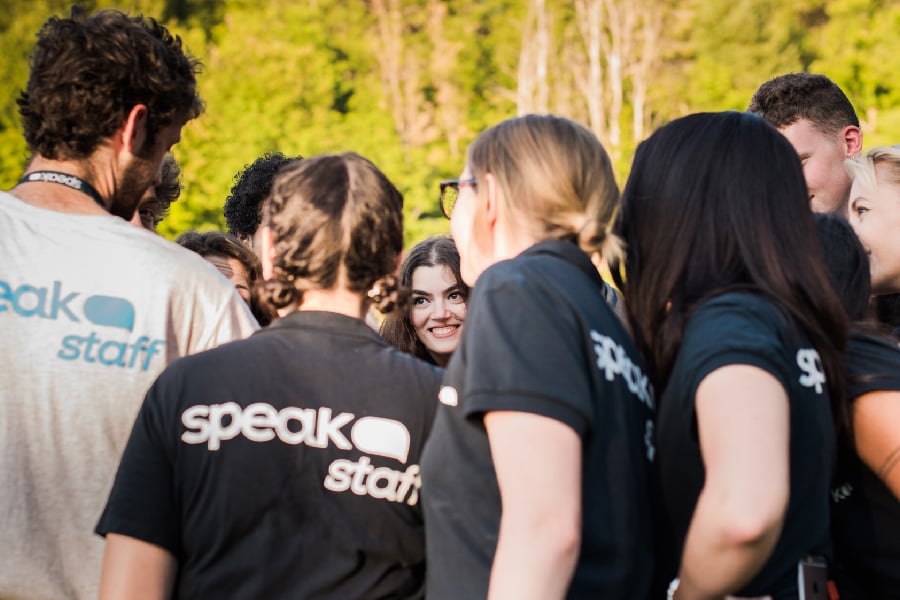
The key isn't geography: it's immersion structure. A camp in Italy with a 1:1 student-to-native-speaker ratio offers something no study-abroad programme can guarantee: a dedicated native-speaking peer for every Italian student, for the entire duration of the camp. 14–16 hours of real English per day, at a lower cost than a fortnight abroad.
14–16 hours of real English per day, at less than the cost of a fortnight abroad
At Speak Teens every Italian student has a dedicated native-speaking Teen Anglo for the whole experience. Camp 1: 3–10 Jul · Camp 2: 10–17 Jul 2027.

When study abroad makes sense
This comparison doesn't mean study abroad is useless. It makes sense for: students who are already fluent and want to refine their accent or immerse in a culture; older teens seriously considering university abroad; advanced learners consolidating a specific accent. For an Italian teenager at intermediate level who wants to make a real leap in fluency and confidence, a 1:1 immersion camp in Italy offers significantly higher linguistic return on investment at a lower cost.
Compared to study abroad, my children confirmed that at Speak Teens they spoke far more English!
Silvia Zavarise
Parent, Cremona